How to Meal Prep for the Week: A Simple Step-by-Step Guide
ByProbiotic Diet Editorial
Updated onOctober 1, 2026
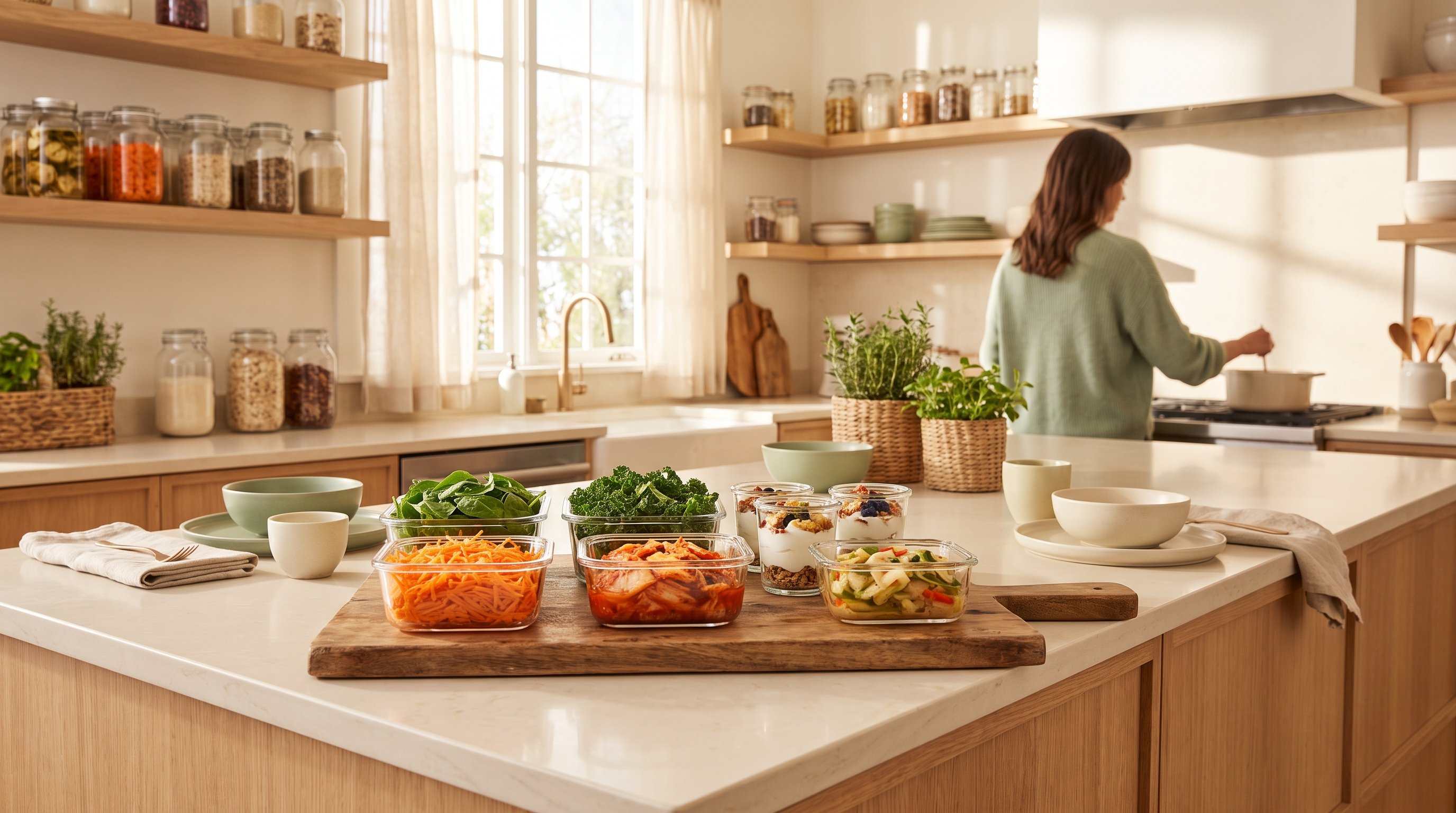
Seven days of meals, planned in one sitting, cut down to about 4-6 containers of prepped food and maybe 2 hours of kitchen time. That is the whole mechanism - decide once, cook once, eat all week without re-deciding.
Meal prep works because it removes the moment of choice, which is usually where healthy eating falls apart. When the food is already made, tired-you does not get to negotiate with hungry-you.
This guide covers whether meal prep actually works, how much to prep, the practical steps, what stalls people out, and how to tell if it's working for you.
Does Meal Prep Actually Work?
The mechanism is simple: decision fatigue is real, and the fewer food decisions you make in a day, the more likely those decisions stay close to your goals.
Do the arithmetic. If you make 3 food decisions a day - breakfast, lunch, dinner - that's 21 decisions a week.
Prep on one day and you've made those 21 decisions in a single sitting, under no time pressure, instead of 21 separate times while hungry, rushed, or tired.
Fewer in-the-moment decisions means fewer chances for the quickest option to win by default.
Why This Beats the Harder Alternative
The harder alternative is deciding what to eat fresh, every single meal, from scratch, while also being hungry.
That's not a willpower problem. It's a design problem - asking yourself to make a good decision at the exact moment you're least equipped to make one.

Meal prep moves the decision earlier, to a calmer moment, and turns the rest of the week into execution rather than negotiation.
That's the whole adherence argument: a plan you don't have to remake every day is a plan you actually finish.
The Quantity Question: How Much to Prep
There's no single right amount - it depends on your schedule, your freezer space, and how many meals you actually eat away from home.
A reasonable starting point is prepping lunches and dinners for 5 days, leaving weekends flexible, which is 10 meals rather than 21.
Find Your Own Number
Count how many meals you actually eat at home or desk versus out, then prep only that number - prepping meals you won't eat just means wasted food and wasted time.
| Weekly Schedule | Suggested Prep |
|---|---|
Full-time desk job | 5 lunches, 5 dinners |
Mixed home and travel | 3 lunches, 4 dinners |
Mostly home | 7 lunches, 7 dinners |
Shift work | Grab-and-go portions only |
The Practical Question: How to Actually Do It
Pick one day - most people use Sunday - and block out roughly 2 hours.
Choose 3-4 base recipes that reheat well, batch-cook proteins and grains separately, and portion into containers once everything has cooled.
This is where a meal plan built around food you already like matters - prep only works long-term if you don't dread eating the result on day four.
Probiotic Diet gives you a plan with over 1000 recipes, so prep day can rotate through meals that actually appeal to you instead of the same three dishes on repeat.
Keeping a simple tracker for what you've prepped, eaten, and still have in the fridge also cuts down on food going to waste.
Comparison: Prep-Ahead vs Daily Cooking
Most people aren't choosing between meal prep and takeaway - they're choosing between prepping ahead and cooking fresh every day.
Here's how the two stack up on the things that actually decide whether you stick with either one.
| Factor | Prep-Ahead | Daily Cooking |
|---|---|---|
Time per week | About 2 hours total | 30-60 min daily |
Decisions made | Once, calmly | Every meal, under pressure |
Variety | Set in advance | Flexible day to day |
Waste risk | Low if portioned right | Higher, impulse buys |
Consistency | Easier to hold | Depends on daily energy |
The Forbidden Promise, Answered Honestly
Meal prep will not target a specific body area, and no amount of batch-cooked chicken and rice melts fat from one spot - the body does not work that way.
It also won't produce overnight change, and it doesn't cure or treat anything.
What it actually does is make the deficit, or the healthier pattern, easier to hold day after day, which is the part that actually adds up over time.
Levers That Change the Result
Not every part of meal prep matters equally - these three make the biggest difference to whether it sticks.
What Actually Moves the Needle
- Picking food you like - prepped meals you don't enjoy get skipped by Wednesday, no matter how healthy they are
- Portioning immediately - containers made the moment food is cooked get eaten; food left in one big dish gets forgotten
- Protecting the prep slot - treating the 2-hour block as fixed, not optional, is what makes it a habit instead of a one-off
How Long Until You See Results?
The first week or two is mostly logistics - working out container sizes, which recipes reheat well, and how much you actually eat.
Give the system time to settle before judging it, since the early weeks are about building the routine, not the outcome.
Once prepping becomes automatic rather than effortful, it stops costing willpower - that shift is the real marker of progress, more than any number on a scale.
Your First Four Weeks
The order you build habits in matters more than how perfectly you do it on day one.

| Week | Focus |
|---|---|
Week 1 | Prep 2-3 simple recipes only |
Week 2 | Add variety, adjust portions |
Week 3 | Fix the recipes that got skipped |
Week 4 | Lock in a fixed prep day |
What Stalls Progress
Prepping Food Nobody Wants to Eat
Stop choosing recipes based on how healthy they look and start choosing ones you've genuinely enjoyed before - adherence beats ambition every time.
No Fixed Prep Day
If prep happens whenever there's time, it eventually happens never - block the same slot every week until it's automatic.
Over-Prepping Variety
Ten different recipes for one week sounds exciting and usually means half get wasted - fewer recipes, bigger batches, less decision fatigue.
No Container System
Food stored loosely in big dishes gets ignored; pre-portioned containers get eaten because they're already a single, grab-and-go decision.
Treating One Bad Week As Failure
A missed prep day doesn't undo the habit - picking it back up next week is what makes it sustainable.
Why Probiotic Diet Works for This
Meal prep only lasts if the food itself holds your interest, and that's the part most prep guides skip.
Probiotic Diet gives you a tailored plan with over 1000 recipes to rotate through, trackers to keep tabs on what you're eating and drinking, and simple challenges to keep the habit going past week one.
Final Thoughts
Meal prep is not complicated - it's one deliberate decision that replaces 21 small, tired ones.
Start small, pick food you actually like, and let Probiotic Diet handle the planning so the only thing left to do is cook, portion, and eat.
Frequently Asked Questions
How Much Time Does Meal Prep Actually Save?
Instead of deciding and cooking separately at each of 21 weekly meals, prep collapses that into roughly 2 hours once. The saved time is less about cooking speed and more about not having to think about food all week.
Isn't Meal Prep Just Eating the Same Thing All Week?
It can be, but it doesn't have to be - prepping 3-4 different base recipes gives variety without multiplying the work. Rotating recipes week to week keeps things from getting repetitive.
What If There's No Time for a 2-Hour Prep Session?
Prep can be split across two shorter sessions, or scaled down to just 2-3 meals instead of a full week. Even partial prep removes some daily decisions, which is where the benefit comes from.
Why Does Meal Prep Usually Fall Apart After a Couple of Weeks?
Most people quit because they prepped food they didn't actually want to eat, or never fixed a set day for it. Probiotic Diet's recipe variety and tracking tools are built to keep that from happening by keeping the food interesting and the routine visible.