High-Fiber Breakfast Foods That Actually Keep You Full
ByProbiotic Diet Editorial
Updated onOctober 1, 2026

A bowl of oats with berries and seeds can carry 10 to 12 grams of fiber before 9am - roughly a third of a day's target in one meal.
Fiber slows digestion and feeds the bacteria living in your gut, which is why a fiber-heavy breakfast tends to hold off hunger longer than a sugary one.
This guide covers what counts as high fiber, how much you actually need, a simple table to build your own plate, and what tends to stall people out after week one.
Does a High Fiber Breakfast Actually Work?
Fiber does not digest the way sugar or refined starch does. It passes through slower, which blunts the sharp rise and fall in blood sugar that leaves you hunting for a snack by 11am.
Here is the honest arithmetic. A white bagel has around 2 grams of fiber.
Swap it for a bowl of oats with a tablespoon of chia seeds and a pear, and you are looking at closer to 14 grams - seven times more, for a similar number of calories.
That difference does not change overnight, and no single breakfast changes your whole day on its own.
But stacked over weeks, a fiber-forward breakfast means fewer mid-morning dips and an easier time keeping your overall eating in a sensible range.
Why This Beats the Harder Alternative
The harder alternative is skipping breakfast entirely or counting every calorie by hand, and most people cannot keep that up for long.
Swapping a low-fiber breakfast for a high-fiber one is a substitution, not a restriction - you are not removing a meal, you are changing what is on the plate.
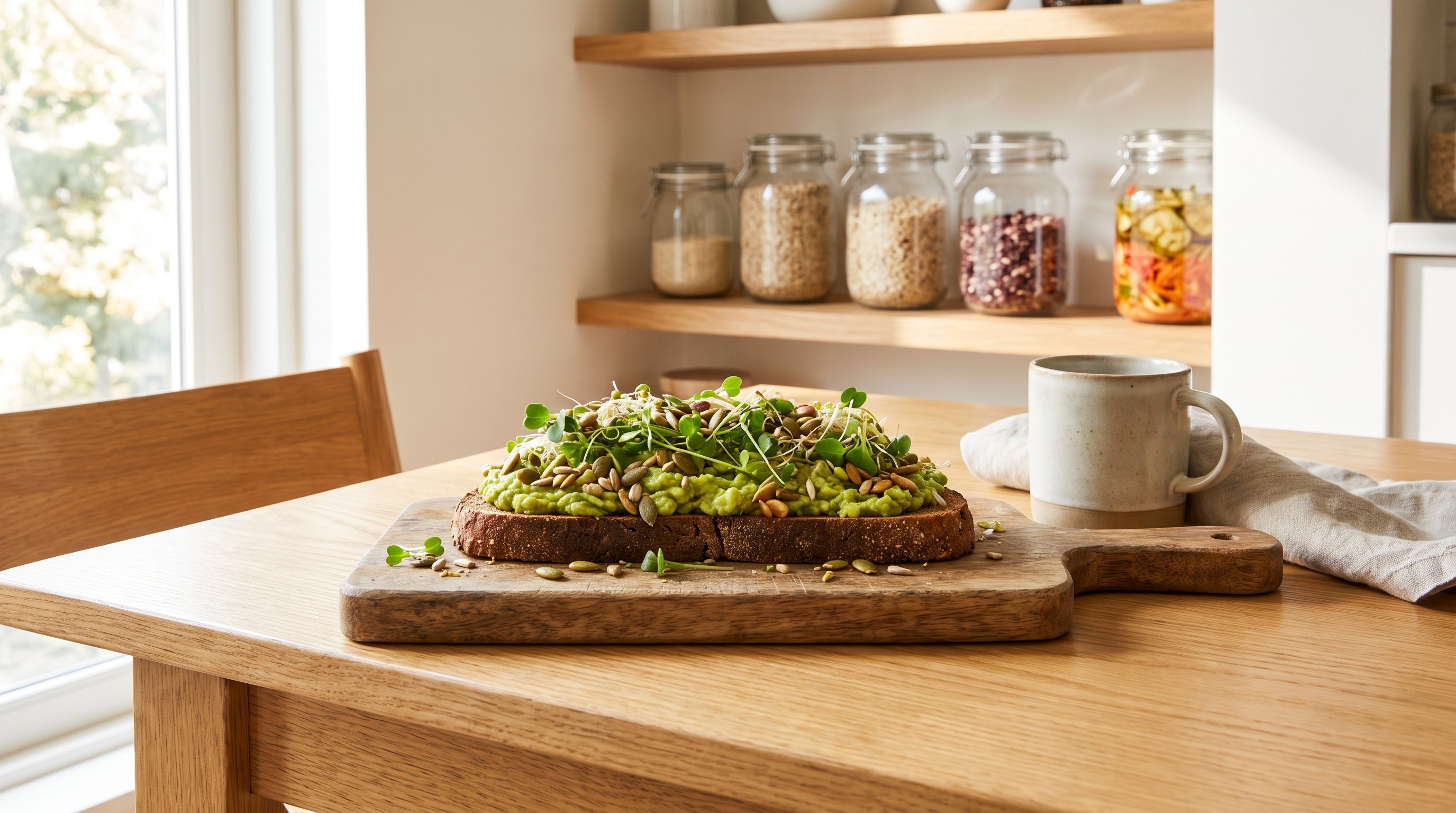
Substitutions survive busy weeks because they do not ask you to white-knuckle through hunger.
A bowl of fiber-rich oats takes the same five minutes as a bowl of low-fiber cereal, so the effort cost is close to zero while the payoff compounds.
The Quantity Question: How Much Fiber Do You Need at Breakfast?
There is no single correct number, because it depends on your overall daily target and what the rest of your day looks like.
A reasonable aim for breakfast alone is somewhere between 8 and 12 grams, which leaves room to hit a fuller daily total across lunch and dinner.
Find Your Own Number
Start by checking what your usual breakfast gives you now, then add one high-fiber swap and see how the number moves - that single change is often the easiest win of the day.
| Food | Fiber Per Serving |
|---|---|
Rolled oats, 1 cup cooked | 4 grams |
Chia seeds, 1 tablespoon | 4 grams |
Raspberries, 1 cup | 8 grams |
Pear with skin, medium | 5 grams |
Wholegrain toast, 1 slice | 2 grams |
Mix and match from a table like this and hitting 10 grams before lunch stops feeling like a project.
The Practical Question: Making It Fit a Real Morning
Knowing the numbers is one thing - fitting them into a morning where you have ten minutes and half a cup of coffee left is another.
This is where a meal plan built around food you already like matters more than any chart.
Probiotic Diet includes recipes designed to make a high-fiber, gut-friendly breakfast something you can actually repeat, with trackers to keep an eye on how your week is adding up.
The goal is not a perfect breakfast every day - it is a repeatable one most days.
Comparison: High Fiber Breakfast Versus the Usual Options
Most people are choosing between a handful of familiar breakfasts without ever lining them up side by side.
| Breakfast Option | Fiber | Effort |
|---|---|---|
Oats with berries and seeds | 10-12 grams | Low |
Wholegrain toast with avocado | 7-8 grams | Low |
Greek yoghurt with granola | 4-6 grams | Low |
White bagel with cream cheese | 2 grams | Low |
Sugary cereal with milk | 1-2 grams | Low |
The effort column is the same across the board, which is really the point - the fiber gap is not about cooking skill, it is about which box you reach for.
The Forbidden Promise, Answered Honestly
No breakfast burns fat from one area of the body, and no food cures anything or reverses a health condition.
A high-fiber breakfast will not melt anything off overnight, and anyone telling you otherwise is selling a shortcut that does not exist.
What it genuinely does is keep you fuller for longer and support the bacteria in your gut, which can make the rest of your day's eating easier to manage.
That is a smaller promise than the one people want, but it is the one that is actually true.
Levers That Change the Result
Not every change carries equal weight - some levers move the needle far more than others.
What Actually Moves the Needle
- Consistency over the week - one high-fiber breakfast does little, but five or six repeated most weeks is where the difference shows up.
- Pairing fiber with protein - adding yoghurt, eggs or nuts to a fiber-rich base extends the fullness window further than fiber alone.
- Water intake alongside fiber - fiber needs fluid to do its job well, so a dry high-fiber breakfast without enough water can feel heavier than it should.
How Long Until You See Results?
This is where most people quit - they expect to feel different within a few days and nothing dramatic happens, so they assume it is not working.
Digestive comfort and fullness often shift before anything else, and that can take a few weeks of fairly consistent habits to settle in.
Weight and energy changes, if they come, tend to show up more slowly and unevenly, which is normal rather than a sign of failure.
Patience here is not passive - it is what lets the habit become automatic instead of something you have to decide on every single morning.
Your First Four Weeks
The order you build these habits in matters more than hitting a perfect number on day one.

| Week | Focus |
|---|---|
Week 1 | Swap one breakfast for a fiber option |
Week 2 | Add a fruit or seed topping daily |
Week 3 | Pair breakfast with a protein source |
Week 4 | Track fullness and adjust portions |
By week four, the choice has stopped being a decision and started being a default, which is really the whole aim.
What Stalls Progress
Jumping Straight to a High Target
Going from 5 grams to 30 grams overnight can leave you uncomfortable and ready to quit - raise the amount gradually over a couple of weeks instead.
Forgetting the Water
Fiber without enough fluid can feel heavy rather than filling - keep a glass of water alongside breakfast as a standing rule.
Treating One Good Breakfast As the Whole Plan
A single fiber-rich meal cannot offset a day of low-fiber choices - think about the pattern across the week, not one plate.
No Variety
Eating the exact same bowl daily gets boring fast and boredom is how habits die - rotate between two or three go-to options to keep it easy to repeat.
Not Tracking Anything
Without a simple way to see your patterns, it is hard to know what is actually working - a basic tracker removes the guesswork.
Why Probiotic Diet Works for This
Building a high-fiber breakfast habit is less about willpower and more about having the right options in front of you each morning.
Probiotic Diet pairs over 1000 recipes with progress tracking for water, weight and steps, so the fiber habit sits inside a routine you can actually see and adjust, rather than a plan you have to remember on your own.
Final Thoughts
A high-fiber breakfast is one of the simplest substitutions available - same effort, same time, a meaningfully different plate.
Start with one swap this week, keep it boring and repeatable, and let Probiotic Diet handle the tracking so you can focus on just eating the thing.
Frequently Asked Questions
How Many Grams of Fiber Should Breakfast Have?
Somewhere between 8 and 12 grams is a sensible target for most people, leaving room to hit a fuller total across the rest of the day. Exact needs vary, so treat it as a starting point rather than a fixed rule.
Will a High Fiber Breakfast Upset My Stomach?
Raising fiber too fast can cause discomfort, which is why a gradual increase over a couple of weeks works better than jumping straight to a high number. Pairing fiber with enough water also makes the adjustment smoother.
I Don't Have Time to Cook Breakfast - Does This Still Work?
Several high-fiber options, like overnight oats or yoghurt with seeds, take under five minutes to prepare the night before or the morning of. The time cost is close to what a low-fiber breakfast already takes.
Why Did I Stop Noticing a Difference After a Few Weeks?
This is often the point where the new habit has simply become normal, which is actually a sign it has stuck rather than a sign it stopped working. Checking progress inside Probiotic Diet can help you see the pattern over weeks instead of judging it day by day.